
Some kitchen tools are so familiar that nobody gives them a second thought. Others can sit quietly in a drawer for decades and become almost impossible to identify when a new generation discovers them. A small metal gadget with a handle, a wheel, and an unusual shape can easily look more like something from a workshop than something that belongs beside a cutting board.
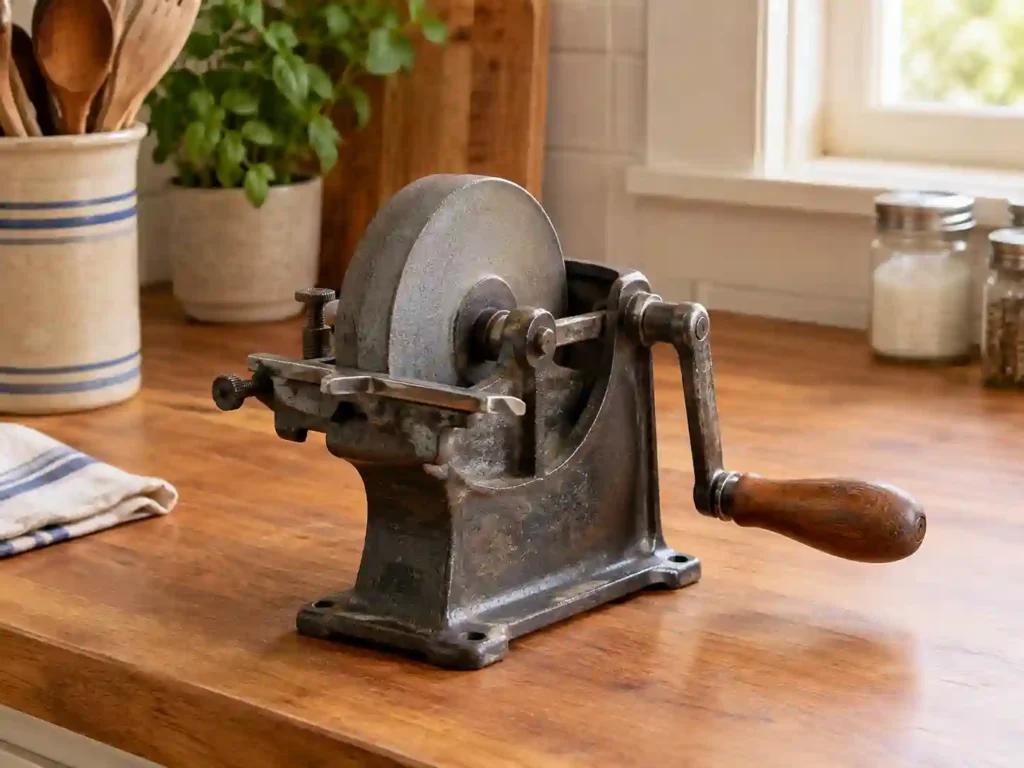
Maybe you have seen one while cleaning out an older kitchen, sorting through a family home, or looking through photographs of vintage household equipment. At first glance, the object may leave you wondering what it was designed to do. There may be no obvious label, no instructions, and no modern-looking features to provide an easy answer.
Then somebody recognizes the shape and explains that it is an old-fashioned knife sharpener. Suddenly, the handle and rough-looking wheel make much more sense. What initially seemed like an obscure piece of equipment was actually a practical kitchen tool designed to help maintain one of the most frequently used items in the kitchen: the knife.
The Mystery Object That Was Actually a Knife Sharpener
Vintage kitchen equipment often looks very different from the compact gadgets found in stores today. Older tools could have heavier metal frames, visible mechanical parts, wooden handles, or simple rotating components. Because of that, it is easy to mistake a vintage kitchen sharpener for a workshop tool or another type of household device.
Many traditional sharpeners were built around a simple idea: use an abrasive surface to help restore a more functional edge to a dull knife. Some designs included a rotating wheel that was turned with a handle or crank. As the wheel moved, its abrasive surface could interact with the blade.
The exact construction varied from one sharpener to another. Some were designed to rest on a countertop or table, while other versions were made to be held or positioned by hand. The materials, wheel shape, frame, and sharpening mechanism could also differ considerably.
That variation is one reason an unfamiliar vintage gadget should not automatically be used simply because it looks like a knife sharpener. Identifying the design first is a much safer approach, especially when the tool has been sitting unused for many years.
How an Old-Fashioned Knife Sharpener Works
The basic principle behind sharpening is fairly simple. With regular use, the fine edge of a knife can become less effective. Sharpening involves working on that edge so the blade can regain a more functional cutting surface.
In a traditional wheel-style sharpener, the abrasive wheel provides the surface that interacts with the blade. A handle or crank may be connected to the wheel, allowing the user to rotate it manually. The mechanical movement is straightforward, but the correct technique depends on the particular tool.
This is where vintage sharpening equipment differs from the simple appearance of the device. A wheel, handle, and metal frame may look self-explanatory, but the intended angle and method can vary. Some sharpeners were made for particular kinds of knives, while others were designed for more general kitchen use.
The condition of the device also matters. A tool that has been stored in a drawer, basement, attic, or old kitchen cabinet for years may have accumulated rust, dirt, or wear. A damaged wheel or loose mechanical component can make an otherwise interesting vintage tool unsuitable for immediate use.
The Wheel Is Usually the Big Clue
When trying to identify a mysterious kitchen gadget, the wheel is one of the first features worth examining. A rough or textured wheel connected to a handle or crank can be an important clue that the device was designed for sharpening.
Look at how the wheel is positioned within the frame. Notice whether the handle appears to turn the wheel and whether the overall construction seems designed to bring a blade into contact with the abrasive surface. These details can help distinguish a sharpening tool from other vintage gadgets that happen to contain a wheel.
The shape alone, however, is not enough to establish exactly what the tool is. Vintage household equipment came in many forms, and similar-looking mechanical parts could serve very different purposes. If there is a manufacturer’s name, model number, marking, or other identifying detail, that information can be especially useful when researching the object.
Why Knife Sharpeners Were Practical Kitchen Tools
A kitchen knife is used repeatedly for tasks such as cutting, slicing, chopping, and preparing ingredients. Maintaining the cutting edge was therefore a practical part of caring for kitchen equipment. Before today’s compact sharpening gadgets became familiar, a mechanical sharpening tool could provide a straightforward way to work on a dull blade.
Older tools also reflect a time when many household objects were built with visible mechanical parts. Instead of hiding the mechanism inside a compact plastic body, a vintage sharpener might clearly show the wheel, frame, axle, and handle. That exposed construction can make the object fascinating today, even when someone has never seen one used.
For people interested in vintage kitchens, these tools offer a small glimpse into everyday household routines. They were not necessarily complicated inventions. Their appeal comes from the combination of practical purpose, durable construction, and a design that is very different from many modern kitchen accessories.
What to Do If You Find One in an Old Kitchen
If you discover a strange metal tool while cleaning an older kitchen, take a moment to inspect it before putting it to work. Start by looking for identifying marks or labels. Check the handle, frame, wheel, and any visible mechanical parts. A manufacturer’s name or model information can make identification much easier.
Next, examine its physical condition. Look for obvious rust, cracks, missing pieces, loose parts, or damage to the sharpening wheel. Years of storage can affect older equipment, and something that looks sturdy may still require careful inspection before it is handled or operated.
It is also wise to identify the exact design before using it on an important kitchen knife. Not every vintage sharpener works in the same way, and not every sharpening mechanism is appropriate for every blade. A little research can help you understand what the tool was originally intended to do and how it was designed to be used.
A Small Tool With a Practical History
What makes an old knife sharpener interesting is not only its unusual appearance. It also represents a very practical approach to kitchen maintenance. The basic purpose was simple: help keep knives useful by working on their cutting edges.
Today, a compact kitchen gadget might accomplish a similar task while taking up very little space and requiring almost no explanation. An older mechanical sharpener, by comparison, makes its function visible. The rotating wheel, sturdy frame, and hand-operated mechanism show exactly how much of the work was once done through a simple mechanical process.
So the next time you encounter a mysterious metal object in an old kitchen drawer, do not assume it is useless simply because its design looks unfamiliar. A handle and abrasive wheel may be the clues you need to recognize a vintage knife sharpener hiding in plain sight.
And if you do find one, identification should come before experimentation. Learn what the particular device was designed for, inspect its condition, and make sure its sharpening method is appropriate for the blade you intend to use. Sometimes an object that looks completely strange at first turns out to have had a very ordinary and useful place in the kitchen.