
Have you ever looked outside and noticed a flock of birds flying much closer to the ground than usual? Maybe they were swooping over your backyard, skimming across a field, moving low above a lake, or suddenly dropping together before changing direction.
It’s easy to wonder whether something is about to happen. Does low-flying bird activity mean rain is approaching? Could a storm be on the way? Or are the birds simply responding to something happening in their surroundings?
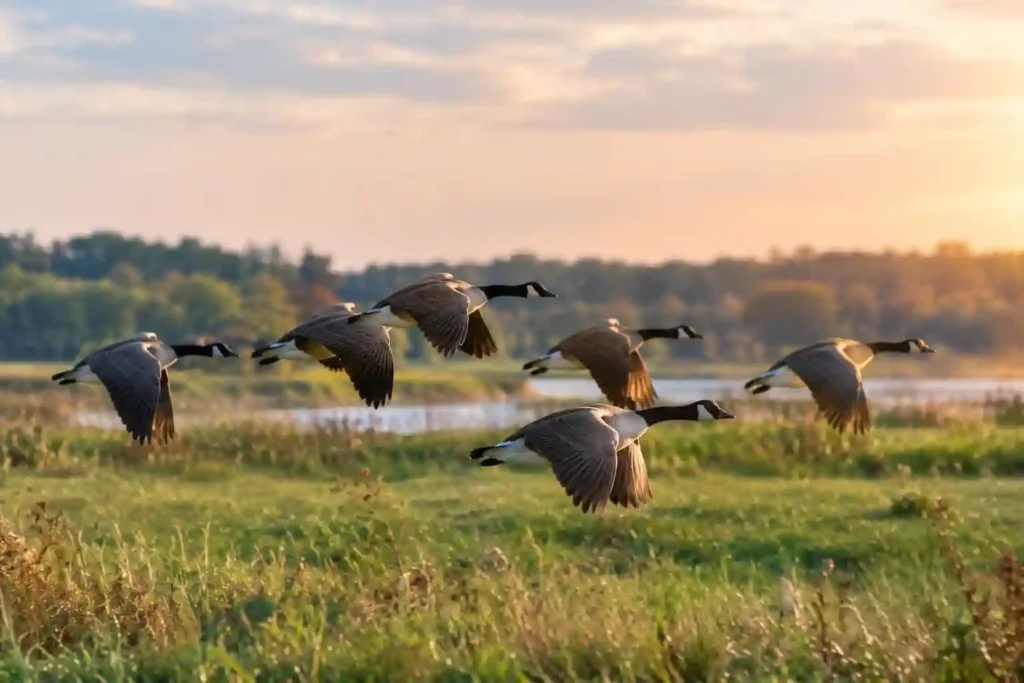
Birds are highly responsive to their environment, but there isn’t one universal explanation for flying low. Their altitude can change because of food, wind, predators, temperature, migration, water, landscape features, or simply because they are getting ready to land.
That means a flock flying just a few feet above the ground may be doing something completely ordinary. The most useful clues usually come from watching the birds’ behavior, direction, formation, and surroundings rather than focusing only on how low they are flying.
What Does It Mean When Birds Fly Low?
Low-flying birds can have many different reasons for changing altitude. A bird may fly lower because food is concentrated near the ground, because the wind is more favorable at a particular height, because it is approaching a landing area, or because it has reacted to a predator.
The behavior itself can provide important clues. Ask yourself whether the birds are repeatedly swooping, chasing insects, flying steadily in one direction, gathering tightly together, scattering suddenly, or heading toward a particular tree, field, river, shoreline, or building.
Those details can tell you considerably more than altitude alone.
1. They May Be Looking for Food
One of the simplest explanations for low flight is feeding. Many birds spend time close to the ground because that’s where their food can be found.
Insect-eating birds may fly low over lawns, fields, gardens, or open areas while searching for flying insects. Swallows and other aerial insect hunters can change their flight height as they follow concentrations of insects through the air.
If you notice birds repeatedly dipping, turning, swooping, and rising again, they may simply be hunting. Several birds repeatedly converging on the same patch of grass or open space can also be a clue that they’re taking advantage of a local food source.
In this situation, the low flight isn’t necessarily connected to changing weather. The birds may simply be following their next meal.
2. Strong Winds Can Change Their Flight Height
Wind is another important factor. Air movement can vary considerably at different heights, and birds may change altitude when they encounter different wind speeds or directions.
Some birds can take advantage of favorable air currents, while others may adjust their flight to reduce the effort needed to travel. If you notice birds changing altitude on a windy day, they may simply be responding to the conditions around them.
Flight requires energy, so birds have good reason to use favorable conditions whenever they can. A lower flight path may sometimes provide a more suitable route, especially when the surrounding terrain or wind makes one altitude more convenient than another.
A sudden change in flight height on a windy day therefore doesn’t automatically mean that severe weather is approaching.
3. They Could Be Preparing to Land
Sometimes birds are simply going somewhere nearby. Birds need to land regularly to rest, feed, drink, nest, roost, or interact with other birds.
If a flock gradually descends as it approaches a group of trees, a field, a shoreline, or another suitable habitat, you may be watching a normal landing approach.
From the ground, a change in altitude can look sudden or unusual, but it may simply be the final stage of an ordinary trip.
4. They May Be Responding to a Predator
A flock suddenly dropping, scattering, or changing direction can sometimes be responding to a predator. Smaller birds may react quickly when a hawk, falcon, or other threat enters the area.
Their response can include diving toward lower ground, bunching together, rapidly changing direction, or breaking apart before regrouping.
Look for Sudden Changes
If the birds were flying normally and then suddenly dive or scatter, something may have triggered the reaction. A predator is one possibility, but it isn’t the only one. A person, vehicle, loud noise, another animal, or another disturbance can also cause birds to alter their behavior.
The important clue is the sudden change. The birds are responding to something in their immediate environment, even if you can’t identify exactly what caught their attention.
5. Migration Can Change Flight Patterns
Migration can also produce unusual-looking flight behavior. Migrating birds don’t necessarily remain at one fixed altitude for an entire journey. Flight height can change with wind, terrain, weather conditions, species, time of day, and other environmental factors.
Some species migrate mainly at night, while others travel during daylight. During migration periods, you may notice larger groups moving steadily in the same direction or forming coordinated patterns.
If many birds suddenly appear to be traveling together in one direction during a seasonal migration period, their behavior may have more to do with movement between locations than with an approaching storm.
6. They May Be Following the Landscape
Birds move through landscapes rather than simply flying across an empty sky. Rivers, coastlines, valleys, forests, fields, and other natural features can influence their routes.
A flock flying low along a river, for example, may be following a route that provides access to food or suitable habitat. Birds can also become familiar with landscape features and repeatedly travel through the same areas.
What looks mysterious from a backyard may actually be a practical route from the birds’ perspective.
7. Water Can Influence Low Flight
If birds are flying unusually low over a lake, pond, river, or ocean, take a moment to watch where they’re going.
Some birds naturally travel close to water when moving between feeding and resting areas. Others may be searching for food or preparing to land. Water can also create different local wind conditions that influence how birds move through the air.
For that reason, low flight over water isn’t automatically a sign that rain is coming. The birds may simply be using the area for food, travel, or rest.
8. Temperature Can Influence Bird Activity
Temperature and other atmospheric conditions can affect the behavior of birds and the animals they depend on for food.
On warmer days, insects may become more active or abundant, creating feeding opportunities for insect-eating birds. On cooler days, birds may search for food differently or concentrate their activity in other areas.
Because food availability can change with environmental conditions, a flock that flies low one day and higher the next may simply be responding to where its food is located.
Do Birds Really Know When Rain Is Coming?
The idea that birds behave differently before rain has been around for generations. There is a reasonable environmental explanation for why people might notice such changes.
Birds are sensitive to conditions around them, including wind, temperature, atmospheric pressure, and changes in food availability. Some species can alter their activity or movements when environmental conditions change.
However, that doesn’t mean low-flying birds provide a reliable forecast of future rain. A bird can respond to conditions that are already changing without specifically predicting what the weather will be hours later.
Low-Flying Birds Don’t Guarantee Rain
The familiar idea that birds flying low means rain is coming is memorable, but it is far too simple to apply to every species and every situation.
Low flight can result from feeding, wind, predators, migration, habitat, water, or an approaching landing area. Weather may sometimes be part of the picture, but altitude alone isn’t enough to identify what is happening.
It’s better to treat low-flying birds as an interesting environmental clue rather than a guaranteed weather forecast.
Why Do Birds Sometimes Fly Higher or Change Their Flight Before Bad Weather?
Bird responses to changing weather can vary considerably. Some birds may reduce activity or seek shelter when conditions become unfavorable, while others may alter their movement or flight height.
The exact response depends on the species and the circumstances. Wind, temperature, pressure, visibility, food availability, and the bird’s immediate needs can all influence what you see.
There isn’t a universal rule that connects one specific flight height with one particular type of weather.
What Does a Large Flock Flying Low Mean?
Seeing dozens or even hundreds of birds flying together can be impressive, especially when the flock moves close to the ground.
If the group travels steadily in one direction, the birds may be moving between feeding and resting areas or traveling as part of migration. If they repeatedly dive toward the ground, feeding may be the reason.
A flock that suddenly changes direction, compresses into a tight formation, or moves rapidly in several directions may be responding to a predator or another disturbance.
The Shape of the Flock Matters
Formation can provide useful clues. A coordinated flock traveling steadily is different from a group that repeatedly changes direction.
A flock that rises and falls together may be responding to wind or following the movements of nearby birds. Rapid, synchronized changes can also occur when birds are reacting to a perceived threat.
The more details you observe, the easier it becomes to understand what the flock may be doing.
Why Do Birds Suddenly Drop From the Sky?
A flock suddenly descending can look alarming, but there are several possible explanations. The birds may be reacting to a predator, following food below, adjusting to strong wind, approaching a landing area, responding to a disturbance, or reacting to changes in local flight conditions.
- A predator entering the area
- Strong or changing wind
- Food concentrated below
- A nearby landing or resting area
- A person, vehicle, or loud noise
- Changes in local flight conditions
- Movement or reactions from other birds
If the birds quickly recover and continue flying normally, the sudden descent may simply have been part of their response to the environment. A different situation would be birds that are actually falling, crashing, visibly injured, or unable to fly normally on the ground.
Can Birds Sense Storms?
Birds can detect environmental changes that may be difficult for people to notice. Changes in atmospheric conditions, wind, temperature, and other environmental factors can influence bird behavior.
That distinction matters. Responding to changing conditions is not the same as predicting the future with certainty.
A bird may react because the environment is already changing. It doesn’t necessarily mean the bird somehow knows that a storm will arrive several hours later.
It’s more accurate to think of birds as highly responsive animals that constantly adjust to their surroundings rather than as natural weather forecasters.
What If Birds Are Flying Very Low Near Your Home?
If birds suddenly begin flying close to your house, look at what is happening around them. The surrounding environment may provide the answer.
- Are insects active around the lawn or garden?
- Is there a tree, field, pond, or other habitat nearby?
- Has something disturbed the birds?
- Is a predator nearby?
- Has the wind become stronger?
- Are the birds repeatedly returning to the same location?
Sometimes the explanation is surprisingly close. A lawn with plenty of insects, a nearby water source, or a sheltered group of trees can turn an ordinary residential area into a useful feeding or resting spot.
When Low-Flying Birds Are Completely Normal
Not every unusual-looking bird behavior has an unusual cause. Birds change their flight patterns throughout the day for many ordinary reasons.
They fly low to feed, lower their altitude when approaching a landing area, follow landscape features, adjust to wind, move between habitats, and travel together as a group. Sometimes they simply choose the flight path that makes sense for where they are going.
That’s part of what makes bird watching so interesting. Once you start paying attention to small details, everyday behavior can become much easier to understand.
Frequently Asked Questions
Does low-flying birds mean rain is coming?
Not necessarily. Birds may fly low because they are feeding, adjusting to wind, responding to a predator, migrating, approaching a landing area, following a landscape feature, or reacting to other environmental conditions. Low flight by itself isn’t a reliable weather forecast.
Why do birds fly low before a storm?
Some birds may change their behavior when atmospheric conditions change, but their response varies by species and situation. Low flight can also happen for reasons that have nothing to do with an approaching storm.
Why are birds flying low over my yard?
They may be searching for insects, moving between nearby habitats, responding to wind, avoiding a predator, or heading toward a place where they can rest or land. Watching what the birds do next can provide useful clues.
Why do birds fly low over water?
They may be traveling along the shoreline, searching for food, responding to local wind conditions, moving between habitats, or preparing to land. Low flight over water doesn’t automatically indicate that rain is approaching.
Do birds know when bad weather is coming?
Birds can detect environmental changes that people may not notice, and those changes can affect their behavior. However, this shouldn’t be interpreted as a universal ability to predict future weather. Their behavior is better understood as a response to the conditions they are experiencing.
Why do birds suddenly fly together in a strange pattern?
Flocks can change formation because of predators, wind, navigation, feeding, or social coordination. Rapid synchronized movement can occur when birds react to a potential threat, while steadier group movement may be related to travel or migration.
Does the direction birds are flying tell you anything?
Direction can provide clues about where birds are going, especially when they are traveling between feeding and resting areas or moving as part of migration. However, direction alone doesn’t provide a reliable weather forecast.
The Next Time You See Birds Flying Low
The next time you see a flock flying unusually close to the ground, don’t immediately assume that rain or a storm is on the way. Instead, pause and watch the behavior for a few moments.
Are the birds swooping repeatedly? Are they diving toward the ground? Are they traveling steadily in one direction? Did they suddenly scatter? Are they following a river, shoreline, road, or field? Do they keep returning to the same area?
These observations can tell you much more than their altitude alone. A flock flying just a few feet above the ground may look like a mysterious signal from nature, but in many cases the birds are simply responding to food, wind, predators, habitat, migration, or another immediate part of their environment.
Once you start looking at the whole picture, low-flying birds become less mysterious and more interesting. Their movements are often practical responses to the world around them, and even ordinary behavior can reveal a surprising amount about what is happening nearby.
So the next time you glance outside and see birds flying unusually low, take a closer look. They may not be predicting the weather at all. They may simply be responding to something happening around them right now.