
“We moved all your furniture into the garage,” Mom texted. “Your uncle’s family needs the downstairs while their home is being renovated.”
I stared at the message from my office parking lot in Raleigh, North Carolina, trying to understand how my mother had managed to make such a major decision about my house without even calling me.
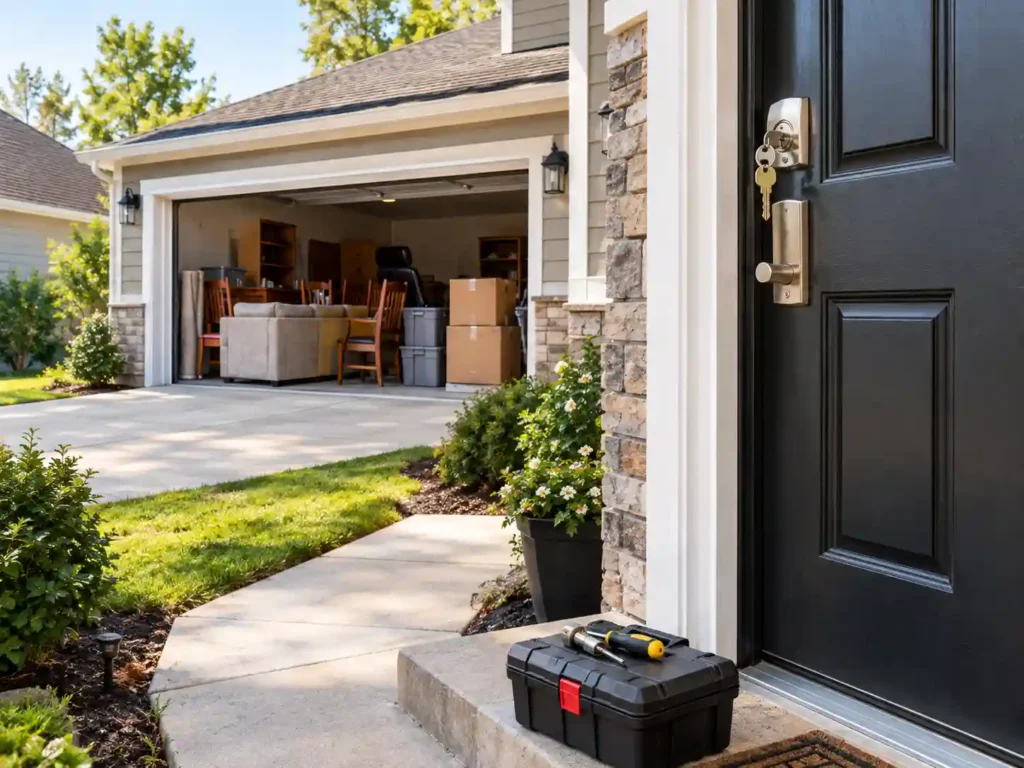
The downstairs. She meant my downstairs.
I had purchased the house three years earlier. The mortgage was mine. The property taxes were mine. The insurance, repairs, maintenance, and every unexpected expense belonged to me.
I immediately typed back, “Put everything back.”
Her response came almost instantly.
“They’re already coming.”
My hands went cold.
I called her. No answer. I called again. Straight to voicemail.
By the time I left work, I had already contacted a locksmith.
Three Vans Arrived
At 6:12 p.m., three vans turned onto my street.
My uncle Richard was driving the first one. His wife, Melissa, sat beside him. Their two teenage sons were in the second van, while the third was packed with boxes, suitcases, plastic containers, and what looked like a large portion of their kitchen.
Richard pulled into my driveway as though nothing about the situation was unusual.
Then he noticed the locksmith.
A man in a navy work shirt was kneeling beside my front door, replacing the deadbolt. I stood nearby with my arms folded.
Richard slowly stepped out of the van.
“What exactly is this?”
He gave a short laugh. “Very funny. Your mother told us the downstairs was ready.”
“My mother doesn’t own this house.”
Melissa climbed out and immediately looked frustrated. “Emily, we drove forty minutes with everything.”
“Then you can drive forty minutes back.”
Richard stepped closer. “Don’t make this bigger than it is. We’re family. It’s temporary.”
“You moved my furniture without asking me.”
“Your mother told us you’d be okay with it.”
“I told her to put everything back.”
His expression hardened. “We have nowhere else to stay tonight.”
“That sounds like something you should have arranged before planning to move into someone else’s home.”
The locksmith stood and handed me a new key.
“Front door’s finished,” he said. “Back door next?”
He glanced toward the garage, where my couch, dining chairs, bookshelves, and desk had been stacked along the walls.
Richard looked toward the vans. “You’re really doing this in front of the boys?”
I looked at the teenagers.
“No. You chose to do this in front of the boys.”
Another car pulled up.
Mom stepped out, visibly upset, and walked across the lawn.
“Open that door right now.”
I stayed where I was.
The Emergency Key
Mom stopped a few feet away.
“Emily, this is unnecessary. Richard’s contractor discovered mold behind the kitchen cabinets. They can’t stay there. Family supports family.”
“I might have considered helping if somebody had asked me.”
She shook her head. “I knew you’d say no.”
That sentence hit harder than I expected.
She had known I might refuse, so instead of asking, she had simply arranged everything first.
She had used the emergency key I had given her after a winter pipe burst the previous year. That key had been provided for emergencies, not to give someone permission to rearrange my home and move other people into it.
Mom gestured toward the garage. “At least let them stay tonight.”
“No.”
“You have three bedrooms. You live alone. What difference does it make?”
“The difference is that it’s my house.”
I held out my hand.
“Give me my emergency key.”
Her eyes narrowed. “After everything I’ve done for you?”
She searched through her purse and eventually placed the key in my palm.
Richard tried another approach.
“We need maybe six weeks.”
“Then rent somewhere for six weeks.”
“Do you know what short-term rentals cost?”
“I know what my mortgage costs.”
One of Richard’s sons, Tyler, quietly opened the second van door.
“Dad,” he said, “can we just stay at a hotel?”
Richard immediately told him to stay out of it.
That changed the mood. Even the teenager could see that the situation had gone too far.
The locksmith returned from the back of the house and handed me two more keys.
“All exterior locks are rekeyed,” he explained. “You should also reset any smart-home access.”
“I will. Thank you.”
Richard looked at him. “How much is she paying you for all this?”
The locksmith simply replied, “Enough to complete the job she hired me to do.”
For the first time that evening, I almost smiled.
The Paperwork I Was Never Supposed to See
Then Melissa said something that made me look at her twice.
“Your mother said you were going to sign something tomorrow anyway.”
Richard immediately looked toward her.
I turned to Mom.
“What something?”
Mom tried to dismiss it as nothing important.
“It was only paperwork. A temporary occupancy agreement. It was meant to protect everyone.”
“You prepared an agreement for me to sign after you moved them into my house?”
She didn’t answer directly.
I extended my hand.
“Then please leave my property.”
Mom looked stunned.
“You wouldn’t actually do that.”
“I’m asking everyone to leave.”
After several uncomfortable moments, Tyler climbed back into the van. Richard eventually followed. Melissa gathered the remaining belongings, and the three vans slowly left the driveway.
As Mom walked away, she said, “You’re going to regret treating family like strangers.”
I looked toward the garage, filled with my displaced furniture.
“You treated my home like my permission didn’t matter.”
That night, I reset the alarm, changed every access code, and moved enough furniture back inside so I could sleep comfortably.
At 11:47 p.m., my phone buzzed.
It was a message from Tyler.
He had sent me a three-page document titled “Temporary Residential Occupancy Agreement.” At the bottom of the third page was a signature line with my printed name underneath it.
Beside the agreement was another page I had never seen before.
It was a handwritten note from my mother saying that if I refused, I should be reminded of what the family had done for me after college.
The Next Morning
I barely slept.
At seven the next morning, I forwarded Tyler’s photographs to my personal email, backed up Mom’s messages, saved the locksmith’s receipt, and photographed every piece of furniture still sitting in the garage.
Nothing appeared badly damaged, but the corner of my desk had a fresh scrape and one dining chair had a cracked spindle.
At 8:30, I contacted my employer’s legal-assistance line. Later that morning, I had a short consultation with a local attorney.
I explained everything that had happened, including the emergency key, the furniture, the unsigned occupancy agreement, and the fact that nobody had spent the night in the house.
The advice was straightforward: keep my documentation, avoid signing anything I did not fully understand, document any damage, and avoid turning the disagreement into a direct confrontation if the family returned.
That afternoon, Mom texted me.
“You embarrassed your uncle. He had to put everyone into two hotel rooms.”
I responded, “Send me the occupancy agreement.”
A few minutes later, Richard called. I let the call go to voicemail.
His message lasted nearly two minutes. He said the agreement was standard, that I was making the situation unnecessarily complicated, and that several weeks in a hotel or furnished rental could cost them thousands.
Then Tyler sent me another message.
“Dad had money saved for a rental. Don’t tell him I told you.”
I asked what he meant.
Tyler explained that the family had known for some time that they would need temporary housing during part of the renovation. The mold discovery had made the situation more complicated, but the need to leave the house had not come completely out of nowhere.
He also mentioned that his father had spent money on backyard improvements during the renovation, including new pavers and an outdoor kitchen.
The situation was becoming clearer.
The Story About My Mother’s Help
I called Mom.
She answered this time.
“Are you finally ready to apologize?” she asked.
“No. I want to know why you told Richard I would agree if they arrived before I came home.”
Mom accused me of changing the meaning of what happened and reminded me that she had supported me after college.
That part was true.
For four months after college, she had helped with rent and groceries while I was getting established. I had never forgotten it.
But I had also repaid her.
The original amount was $6,400. Over the following two years, I transferred $7,000 to her. She had accepted every payment.
I told her that support had mattered to me, but it did not give her permanent authority over my decisions or my home.
Then I mentioned the handwritten note.
Mom went silent.
Finally, she said, “You weren’t supposed to see that.”
I could hardly believe the contradiction.
She had entered my home, moved my belongings, arranged for four people to stay there, and prepared paperwork for me to sign. Yet she was upset that I had discovered the note explaining how to pressure me if I refused.
The call ended shortly afterward.
The Family Finally Heard the Full Story
For the next two days, the family group chat felt like a courtroom without a judge.
One relative said she could not believe I had left teenagers without somewhere to stay. Another pointed out that hotels and furnished rentals were available and that nobody had actually been left without shelter.
Richard said he had never asked for charity.
I asked one simple question:
“Then why didn’t you ask me before planning to move in?”
Nobody answered that directly.
Eventually, Mom wrote a long message about the sacrifices she had made for me and described her support after college as something she had never expected me to repay.
I decided that facts would be more useful than another argument.
I shared screenshots showing the dates and amounts of my repayments, carefully hiding all private account information.
I explained that Mom had helped me with $6,400 after college, that I had repaid $7,000 over two years, and that I appreciated the help. But I also made clear that the assistance did not give anyone permanent control over my home.
The group chat went quiet.
Then my aunt revealed that Mom had told her a different story about helping me buy the house.
Richard called me after seeing the messages.
“Did you really repay her?” he asked.
“Yes.”
He was quiet for a moment.
Then he admitted that Mom had made it sound as though she had played a much larger financial role in my adult life than she actually had.
He also explained that the renovation had started in August. His family had originally set aside money for temporary housing, but additional renovation expenses had reduced the amount they wanted to spend.
Then the mold was discovered.
Mom offered my house as a solution.
Richard admitted that he should have contacted me himself rather than relying on what Mom told him.
That was the first time he acknowledged his part in the situation without trying to justify it.
The Arrangement They Eventually Made
Richard’s family found a furnished townhouse in Cary the following day.
It cost more than they wanted, but it gave them three bedrooms, a kitchen, and a place to stay while their own house was being renovated.
Richard paid $640 to repair my desk, replace the damaged chair, and hire movers to return everything to its original location.
He arrived with the movers but remained outside until I invited him in.
That small detail meant something to me.
Before leaving, he handed me the original occupancy agreement.
It looked fairly ordinary at first, but it contained several details I had never agreed to. It listed a ninety-day maximum stay rather than six weeks, required no rent, and placed utility responsibilities on me. It also included a provision concerning mail at the property.
I had no interest in signing it.
The important thing was that I had never requested the agreement, never agreed to the arrangement, and had never authorized anyone to move into my home.
Richard confirmed that Mom had found the template before I arrived home.
That answered my final question.
This had not simply been a chaotic misunderstanding. Decisions had been made in advance, and the plan depended on putting me under enough pressure that refusing would feel difficult.
A Different Kind of Family Boundary
Three weeks passed before Mom contacted me directly.
She wrote that she hoped I was satisfied now that everyone thought she had acted unfairly.
I told her that I was willing to continue having a relationship with her, but things had to change.
She would no longer have a key to my home. She could not offer my property to anyone. She could not promise my time, money, or space to other relatives. If someone needed my help, I would decide whether I wanted to participate.
She did not speak to me for six weeks.
At Thanksgiving, we eventually saw each other again at a family gathering in Greensboro.
The atmosphere was awkward at first, but Richard greeted me normally. Melissa told me that the townhouse had turned out to be more comfortable than she expected.
Later, Mom made a comment about how things would have been easier if certain people had been more flexible.
Before I could respond, Richard set down his fork.
“Emily didn’t do anything wrong,” he said. “We never should have moved her belongings. I should have called her myself.”
For once, I did not need to explain anything.
That conversation marked the end of the public arguments about my house.
My relationship with Mom did not return to exactly what it had been before. Eventually, though, we established a different routine. She called before coming over. She waited to be invited inside. When relatives needed help, she asked whether I wanted to participate instead of telling them what I would do.
At first, those conversations felt formal and uncomfortable.
Over time, they became normal.
The Locks Stayed
Richard’s family returned home shortly before Christmas.
In January, he invited me over for dinner.
The renovated kitchen looked beautiful. The new patio was finished too, complete with the outdoor kitchen that had helped push the renovation costs higher than expected.
When we walked outside, Richard pointed toward the built-in grill.
“There,” he said. “The world’s most expensive reason I almost got locked out of your family forever.”
I smiled.
“You got locked out of my house,” I corrected.
He laughed.
Before I left, he handed me a small box.
Inside was a brass keychain shaped like a deadbolt.
I looked at him.
“That’s either hilarious or an incredibly questionable choice.”
From the kitchen, Tyler called out, “And I still stand by it.”
I laughed despite myself.
I still have that keychain.
But nobody in my family has a key to my house anymore.
Not Mom. Not Richard. Nobody.
The new locks were never really about keeping my relatives outside. They were about making one simple boundary impossible to misunderstand.
Family relationships can involve generosity, trust, and helping one another through difficult circumstances. But those relationships still require communication and consent when someone else’s home, belongings, money, or personal space are involved.
Being family can create a bond.
It does not give someone ownership of another person’s home.