
You sit down at a restaurant, look over the menu, and realize you are not hungry enough for a full entrée. The kids’ menu offers a smaller serving of chicken tenders and fries that sounds just right. But when you ask for it, the server tells you it is available only to children. Is that a reasonable restaurant policy, or an unnecessary limit on what a paying customer can order?
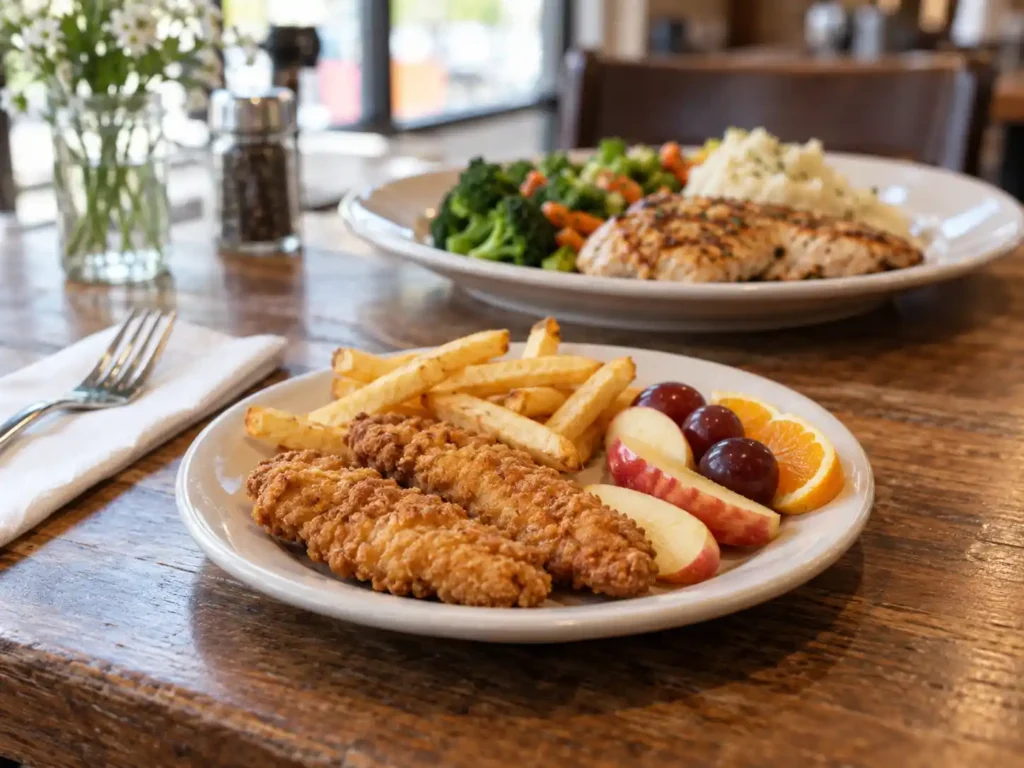
It is a surprisingly lively debate because both sides have a point. Customers may want a meal that matches their appetite and budget. Restaurants, meanwhile, may have set the price of a kids’ meal with family dining in mind. Understanding why those menus exist makes the question more interesting than it first appears.
Why Restaurants Offer Kids’ Meals
A kids’ menu usually makes dining with children simpler. The dishes tend to have smaller portions and familiar flavors, giving families options that suit a child’s appetite without requiring them to order a full-size meal. Chicken tenders, grilled cheese, mini burgers, and macaroni and cheese are common examples. Some meals also include a drink, fruit, or dessert.
The lower price can help make a family visit more manageable. In some restaurants, that price is part of a broader family-oriented offering rather than a general discount on smaller portions. That distinction matters: a restaurant may expect the adults at the table to order regular entrées while children order from the kids’ menu. If the menu lists an age limit, the business has made that expectation clear.
Not every restaurant handles the issue the same way. Some are happy to serve a kids’ meal to anyone. Others apply an age limit only to dine-in orders, while policies elsewhere may be more restrictive. The question is therefore less about a universal rule and more about how individual restaurants choose to design and price their menus.
The Case for Letting Adults Order
The customer’s argument is straightforward: if a smaller meal is on the menu and someone is willing to pay for it, why should age determine whether they can have it? A person might not have the appetite for a large plate. An older adult may find a smaller serving more comfortable, or someone may simply want a quick lunch without bringing home leftovers.
Portion size is also a practical concern. Ordering a full entrée when you know you will eat only a fraction of it can feel wasteful. Taking leftovers home is often an option, but it is not always convenient. A customer might be traveling, heading straight to another appointment, or ordering a dish that will not keep well. In those situations, a smaller meal can be a sensible choice.
Cost is another reason the kids’ menu attracts adults. Someone keeping to a modest dining budget may prefer its lower price to that of a regular entrée. That does not mean every adult who asks for a kids’ meal is trying to take advantage of a restaurant. Sometimes the amount of food and the price simply suit what the customer wants that day.
Then there is the uncomplicated matter of taste. A person may genuinely prefer the choices on the kids’ menu. Simple foods are not exclusively for children, and a small plate of grilled cheese or macaroni and cheese may sound better than any of the larger dishes available. From that perspective, refusing the order can seem odd when the kitchen is already preparing the same meal for other guests.
Why Some Restaurants Restrict the Kids’ Menu
A restaurant may see the matter differently because menu prices do more than reflect the ingredients on a plate. A smaller meal still involves preparation, service, dishes, and the costs of running a dining room. A kids’ meal may be priced to make family visits appealing rather than to serve as the restaurant’s standard small-portion option for everyone.
If many adults chose a lower-priced kids’ meal in place of a regular entrée, that could affect the restaurant’s sales. Whether it would make a meaningful difference depends on the business, but it helps explain why an age limit might exist. The policy can be a way of keeping a family offering distinct from the main menu.
Restaurants also need some flexibility to decide what they sell and under what menu conditions. A clearly stated age restriction gives customers a chance to understand the rule before ordering. The frustrating part is when the limit is not visible and a diner learns about it only after requesting the meal. Clear wording and a courteous explanation can make even an unwelcome policy easier to navigate.
Could Smaller Adult Portions Solve the Problem?
There is a middle ground: offer smaller meals to adults without making them order from the kids’ menu. A half-size entrée, a lunch portion, or a selection of modestly sized dishes would give customers more control over how much food they receive. The restaurant could price those options for adult diners while keeping its children’s meals as a separate family offering.
That approach could help people who want less food but do not want the simpler dishes on a kids’ menu. Someone might welcome a smaller serving of the restaurant’s regular entrée rather than being limited to chicken tenders or grilled cheese. It would also give the server a useful answer when an adult asks for a children’s meal: there is another option that addresses the same concern about portion size.
Smaller adult portions may not work for every kitchen or every dish. Some entrées are prepared as single units and cannot easily be divided, while changing a menu takes planning. Even so, the idea gets to the heart of the debate. Many customers asking for kids’ meals are not necessarily looking for a children’s discount; they are looking for a meal that is smaller, simpler, or less expensive than a full entrée.
Finding a Fair Balance
There is room for more than one reasonable restaurant policy. A business may choose to let adults order kids’ meals, particularly if it values flexibility. Another may keep an age limit because the meals are specifically priced for children. Neither choice automatically settles the broader question of whether customers have enough suitable portion options.
For diners, the easiest approach is to check the menu or ask politely before ordering. If kids’ meals are restricted, asking about a smaller entrée, a side dish, or another modest portion may uncover an option that works. For restaurants, a clearly displayed policy—and, when practical, an alternative for adults with smaller appetites—can prevent an awkward conversation at the table.
So where do you stand? Should anyone be able to order a kids’ meal if they are paying for it? Should the kids’ menu remain just for children? Or would smaller adult portions make the debate unnecessary? The answer may depend on whether you are thinking about a diner’s appetite, a family’s budget, or the restaurant’s reasons for offering the meal in the first place.